
Regeneration in Middlesbrough – progress and opportunities but challenges remain
Renew visited Middlesborough to see one of the UK’s largest urban brownfield regeneration sites. The tour also went to some of the UK’s most deprived estates where progress is being made with regeneration, but significant barriers still exist.
Renewal of homes in the Private Rented Sector (PRS) was also discussed – particularly what can be done to improve the lowest quality PRS homes and the challenges of improving social housing estates when they are pepper potted with Right to Buy Homes, now often in the PRS. 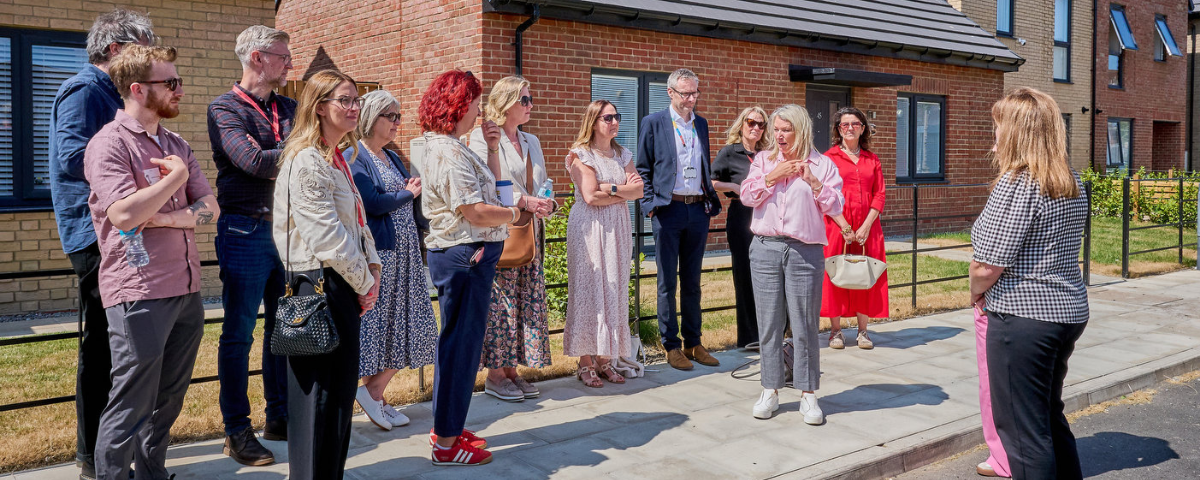
 Middlehaven
The first stop was Middlehaven one of the largest urban brownfield regeneration sites in the country, with capacity for over 2,000 new homes. Middlesbrough Council is looking to take the site forward with Manchester-based developer Capital & Centric with planning permission for the first homes expected in early 2027. The development will be targeted at a younger population and developed as an entirely new urban community.
The development of a new community at Middlehaven is the number one priority in the council’s Place Strategy, Town Centre Strategy and Investment Prospectus. However, the Middlehaven site presents many challenges, including the need for significant remediation and challenging typography. The development of early phases will require significant gap funding, and the council will work closely with Capital & Centric to make the case for investment to Homes England and others.
 Union Village in Gresham
Next up was Union Village in Gresham, one of England’s most deprived neighbourhoods, which has faced deep-rooted challenges for decades. Following Housing Market Renewal funding withdrawal in 2010, 600 homes had been demolished, leaving vacant brownfield land.
Unable to attract private developers, Middlesbrough Council and Thirteen formed a partnership to deliver Union Village, overcoming viability and pandemic delays before completion in 2025. The development provides 145 bungalows, houses, and apartments arranged to support a safe and inclusive community, with homes clustered around secure communal gardens
As well as a tour of the site we also held a discussion about challenges at the lowest end of the Private Rented sector, something which is a significant challenge in Middlesbrough. Housing consultant Carla Keegans, who founded the Ethical Lettings Agency in Redcar and Richard Horniman from Middlesbrough Council shared their experiences.
 Hillside Gardens in Grove Hill
The final stop of the tour was Hillside Gardens in Grove Hill. Most of this estate was built in the 1930s and since the 2004 there have been plans to replace homes on the estate. Some parts of the estate were ranked in the 1% most deprived areas in the country and there were high numbers of empty homes, with some areas having more than 50% of properties sitting vacant.
Residents’ appetite for change was also strong. A community consultation confirmed concerns about crime, anti-social behaviour and drugs. Most people said they didn’t feel safe walking in the estate, three quarters supported selective demolitions, while 86% supported the development of new homes.
But regeneration efforts were dealt a blow by the 2008 financial crash. Prospective private developer partners withdrew and adopted a more risk averse position for some years.
A new masterplan proposing further demolitions and the development of 700 new homes was put forward in 2010. But securing interest from the private sector proved elusive. Meanwhile, selective demolitions progressed, with a total of 600 homes bulldozed in the nine years up to 2014. Some infill sites were built back and around 130 new homes delivered, but large areas of land sat vacant for more than a decade as the economic downturn continued to bite.
The deadlock was broken when Thirteen secured funding support from Homes England to develop 92 new homes for affordable rent on one such site, off Bishopton Road. Work started in 2018 and was completed in 2020. The final handovers of a further 296 new homes for affordable rent, supported by Homes England’s Affordable Homes Programme and a £2.8million contribution from Tees Valley Combined Authority’s Brownfield Housing Fund, are set to take place this month (July 2026).
But there’s lots more to be done. Hundreds more homes are reaching the “end of life” stage and do not meet modern aspirations and expectations. High levels of deprivation remain.
Financial viability remains the biggest barrier to going further. Site clearance costs are one thing, but another obstacle is the significant number of Right to Buy homes on the estate, many of which are private rented. These would require buy outs, and a lack of funding for that makes wholesale regeneration incredibly difficult.
Thank you to the Tees Valley Housing Partnership for arranging the tour and to Sharon Thomas, Chief Investment & Property Officer, Thirteen Group, Emma Speight, Executive Director of Assets and Growth, North Star and Richard Horniman, Director of Regeneration, Middlesbrough Council for sharing their experiences.

