
Liverpool Renew tour showcases ambitious regeneration but viability challenges must be overcome to go further
The Liverpool City Region Renew tour showcased how housing associations, councils, the combined authority and other partners are doing all they can to improve the area. However, there are significant barriers, particularly around viability of regeneration schemes.
We saw some fantastic work to improve town centres, city centres and estates. These schemes will bring about significant economic and social benefits but are only going ahead due to the willingness of providers to invest and go the extra mile for their communities.
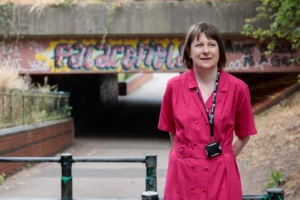 Hallwood Park and Palace Fields
Our first stop was the Hallwood Park and Palace Fields neighbourhoods. Since 2019 Riverside have been working closely with local people to find out how to make the area a better place to live. This section of the tour was led by Riverside’s Stephanie Stankiewicz, Project and Regeneration Administration Officer, Helen Reddington, Director of Home Ownership and Zarine Jewell-Liggins, Housing Services Manager.
The area was identified as in need of regeneration because of a number of challenges, including poor quality homes and community assets. Most of the homes are 41–50 years old and many no longer meet modern standards. There is a high turnover of tenants; and the area has experienced economic decline. Social issues are evident, including antisocial behaviour, limited suitable housing options, and a lack of accessible community spaces. In addition, poor transport connectivity has restricted mobility of residents and their access to services.
The aim of this project is to a create sustainable, vibrant neighbourhood that will attract economically active families and meet the housing and socio-economic needs of local people, including older people, as well as supporting economic regeneration and growth.
Riverside has conducted extensive consultations with residents, businesses, community groups, and other stakeholders through workshops, surveys and events, to make sure plans reflect the community’s needs and aspiration. Since September 2022 alone, over 300 households have been consulted with. During the tour we heard from a resident about the importance of community engagement. He lives in one of the homes due for demolition and spoke about how he looks forward to returning to the area once the project is complete, and how important it is to keep residents updated to build trust.
Ongoing feedback has helped shape and refine plans including for a replacement community centre within the Veterans building in the Local Centre, updating proposals to include the renovation of a pub and stables, and designing apartments as small blocks made up of own-front-door or walk-up homes therefore helping shared maintenance costs of communal areas and creating more activity onto the street. In response to resident feedback that subways could feel unsafe and were a target for crime, plans now include closing two subways and replacing them with safer pedestrian crossings alongside a new landscaped Green Avenue through the Uplands with public realm improvements and new play spaces, and a one-way system on the road that leads to the school, care home and church to help ease the flow of traffic, particularly at school pick up and drop off times.
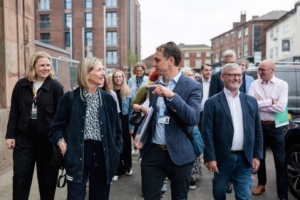 Runcorn Town Centre
Paul Mullane, Director of Development and Sales, Halton Housing and Nathan Rennison, Principal Regeneration Officer, Halton Borough Council took the group to Runcorn town centre.
Driving growth through housing-led investment is a priority for Halton Borough Council, and the Reconnecting Runcorn programme is improving the town. Backed by £23.6 million from the Government’s Towns Fund, the project is now delivering improved community facilities. This includes the Buddhist Temple Hall and Peace Garden, street art, a new youth centre, the extended Brindley Theatre, a health and education hub, a new apartment block for older people, a community owned Canal Trip Boat, and additional studios for an Arts Collective, with more to come.
The aim is to encourage more people to visit and live in Runcorn. Housing is playing a significant role in improving the town. Halton Housing have built Mercia Place, 66 much needed and affordable 1- and 2-bedroom homes for over 55s on a brownfield site on the high street. This has improved the appearance of the high street and residents will use the shops and cafes and other amenities in the local area. Improved homes are also a key part of plans for the Runcorn Waterfront with an outdated tower block and sheltered scheme set to be replaced by new homes.
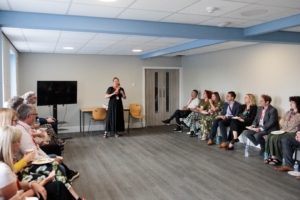 Alt Valley Community Trust
Over lunch the group heard from Lesley Burrows Managing Director of Positive Footprints, which is part of the Regenda Group. Positive Footprints was set up to close the skills gap and open up the world of work for children and young people. Lesley spoke about how Positive Footprints partners with social housing providers and local schools to inspire children and young people to discover their potential, build resilience and develop employability skills.
Stonedale Estate, Croxteth
In the afternoon, we travelled to Croxteth, North Liverpool to see Cobalt Housing’s Stonedale Estate regeneration programme.
Stonedale highlights what can be achieved through sustained commitment. Since developing a resident-led masterplan, Cobalt has invested heavily in transforming the estate through new homes, environmental improvements, public realm investment and tenure diversification. The wider programme has already delivered 145 new homes, with a further 70 social rent homes now underway as part of the next phase of regeneration.
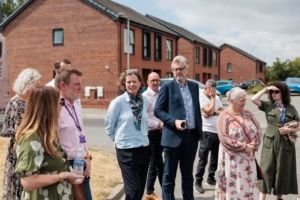
Delegates heard first-hand about the challenges of delivering estate regeneration, including land assembly, particularly when some homes on an estate have been sold through Right to Buy, resident rehousing and the intense support required to deliver this, demolition and infrastructure investment, and the importance of long-term funding and planning certainty. The scheme also demonstrates the continuing demand for affordable housing, with homes designed to meet a wide range of local needs, from family housing and bungalows to accessible and adaptable homes.
Tour of North Liverpool
We then moved onto a tour of North Liverpool led by Leanne Walsh, Head of Regeneration (North), Liverpool City Council, Sophie Bevan, Director of Joint Ventures and Renewal, Torus, and Tracy Gordon, Lead Officer – Housing Partnership, Liverpool City Region Combined Authority.
The visit highlighted early catalytic projects including Torus’ Hartley Locks development on Lightbody Street. Here Matthew Rushton, Senior Development Manager, Torus, showed us around the development of nearly 200 Rent to Buy homes. Other projects including the £81m infrastructure works at Central Docks to bring forward 2350 homes, as well as commercial space and a new public park; and the Hill Dickinson Stadium were also highlighted.
Liverpool North is being driven by a collation of willing partners, founded on the involvement of Liverpool City Council, Sefton Council, Liverpool City Region Combined Authority, and Homes England, and including the community; landlords and anchor institutions such as Torus, Onward and others; and investors and landowners. Consultation is underway on the Liverpool North Docks Mayoral Development Corporation, with the launch targeted for 2027, supporting plans to deliver up to 17,000 homes across the wider area.
Thank you to Liverpool City Region Housing Associations for an interesting and informative visit.
Claire Griffiths, Chair of Liverpool City Region Housing Associations and Chief Executive of Cobalt Housing, said:
“This visit provided a great opportunity to showcase the role housing associations play as long-term investors in our communities. Across Liverpool City Region, our members are delivering much more than new homes – they are regenerating neighbourhoods, attracting investment, boosting economic growth, jobs and training and building much-needed affordable homes.
The projects visited demonstrate what can be achieved when housing associations, local authorities, combined authorities and Government work together with a shared vision. However, they also highlight the scale of commitment required to deliver transformation. Successful regeneration takes time, significant investment and strong partnerships. With the right funding mechanisms, policy stability and planning support, housing associations can do even more to unlock regeneration and deliver the homes and places our communities need.”
You can download our Renew report here.

