
PARTNERSHIP WORKING UNLOCKING A MAJOR TOWN CENTRE BROWNFIELD REGENERATION OPPORTUNITY
Middlesbrough
Context
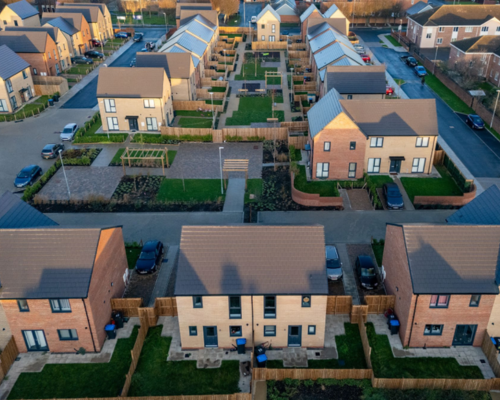
Union Village is a development of 145 two, three and four-bedroom homes on a long vacant 3.5-hectare brownfield site in Gresham, a few minutes’ walk from Middlesbrough town centre.
Gresham is one of England’s most deprived neighbourhoods and has faced deep-rooted social challenges for decades. In 2005, Middlesbrough’s elected Mayor unveiled a 15-year vision to replace the town’s “older housing”, underpinned by the government’s Housing Market Renewal (HMR) programme. The council bought up hundreds of properties, relocated residents, and carried out demolitions across the area.
In 2010, the then government withdrew HMR funding. Plans were scaled back and demolitions halted in 2014. Around 600 Victorian terraced homes had been demolished but a lack of funding to regenerate brownfield sites left large areas vacant for years. The area became associated with crime, fly-tipping and anti-social behaviour.
Project
The site was unable to attract private developers due to the weak market conditions and the costs associated with developing in a town centre location. In response, Middlesbrough Council and Thirteen formed a partnership to unlock the strategic brownfield site and bring forward a housing-led regeneration scheme.
The development, named Union Village, delivers a mix of houses, apartments and bungalows. The scheme faced significant viability challenges linked to remediation, redevelopment costs and weak market conditions. Delivery was also delayed by the pandemic before construction began in 2021. The scheme completed in late 2025.
Barriers to delivery
The scheme requires a long-term regeneration approach that combines the leveraging of private investment, the closing of viability gaps, and sufficient development capacity to manage delivery. These challenges are compounded by the financial constraints facing the Council.
FACTORS SUPPORTING DELIVERY
Leadership & Oversight
Union Village demonstrates the importance of long-term commitment and partnership working between Middlesbrough Council, Thirteen, Homes England and Tees Valley Combined Authority to unlock a stalled brownfield regeneration site.
Funding & Finance
To make the scheme viable, the council disposed of the site to Thirteen on a 999-year lease. Thirteen invested £19million alongside £7.6million from Homes England’s Affordable Homes Programme and £2.5million from Tees Valley Combined Authority’s Brownfield Housing Fund.
Engagement & Accountability
Extensive engagement and partnership building was undertaken with the community and public sector stakeholders. Thirteen created a Community Connector framework to gather information about neighbourhood assets and consult with residents. A series of locality plans spanning 2020-2025 were developed with the community to coordinate activity across Gresham and five neighbouring areas.
Thirteen also engaged the local voluntary, community and social enterprise sector, and monthly resident meetings, pre-tenancy expectations meetings and the Friends of Union Village group helped build early community cohesion.
Capacity & Knowledge
The scheme was delivered through a long-term regeneration partnership between Middlesbrough Council and Thirteen, the largest housing provider in the area. Further capacity and funding was drawn from Homes England, the Tees Valley Combined Authority, and Esh Construction.
A Phase 2 scheme for Gresham is planned, led by Middlesbrough Development Corporation.
Planning, Land & Assembly
The site had previously been acquired and cleared through the HMR programme but had stayed vacant between 2014 and 2021.
Outcomes
Housing and supply
Union Village delivers 145 new homes on previously vacant brownfield land and represents a major supply opportunity within a wider regeneration area.
Economic Growth
With contractor Esh, Thirteen developed a combined social value plan for Gresham and Grove Hill. The plan has so far delivered £4.9m social and local economic value including 10 local jobs and 511 apprenticeship weeks.
Sustainability
All 145 homes achieved an EPC rating of B. Thirteen installed additional insulation within the homes by increasing the required cavity size to 150mm, resulting in greater energy efficiency over above that by the required building regulations.
The scheme was developed with a desire to bring communities and neighbours together, providing residents with areas in which they can meet. It incorporates four communal gardens and three communal courtyards, with planting throughout.
People and place
The development is fully occupied. Secure communal gardens, allotments and resident-led activities are helping foster ownership and stewardship. Between 2020 and 2025, reports of crime fell by 64%, fly-tipping by 65% and anti-social behaviour by 83%.
