
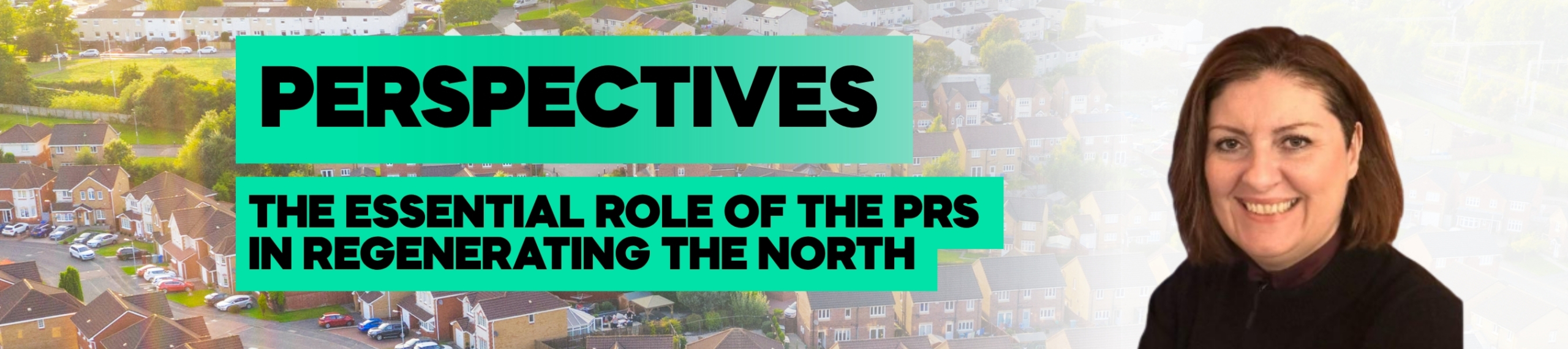
Housing consultant Carla Keegans shares her views on issues in the private rented sector, and why the sector must be at front of mind when planning regeneration, if we want to see impact where it’s needed most. Carla founded The Ethical Lettings Agency in Redcar in Teesside in 2015 and draws on her experience of running a social enterprise that lets, buys and manages properties fairly.
Inclusion of the private rented sector (PRS) in regeneration policies and schemes is essential for achieving the goals of regeneration in the North, both property and people related.
The lower end of the private rent sector is home to some of the poorest, most vulnerable people with complex challenges. In the North, PRS neighbourhoods housing people on lower incomes are disproportionately in and around town centres made up of old terraces that were built for workers of by-gone industries. Slum landlords dominate these neighbourhoods, and they have also been buying up old Right to Buy social housing. This means tenants are living in dilapidated properties. Non-existent neighbourhood management means there is conflict in communities and local town centre economies fail as stigma deters investment.
As industry dwindled in so many of the North’s towns and communities since the national economic decisions from the 1980s, the numbers of people living on low wages and/or on state benefits increased and private landlords began to take root in these communities. As homeowners moved out, landlords bought the properties. They filled a need in the market for cheap properties in accessible locations with little to no checking of references. It became a business model and it’s one that dominates the lower end of the PRS in the areas in the North that need holistic regeneration.
I’ve seen landlords buy up cheap property in concentrated areas and run the homes for around 20 years. The model is based on spending as little as possible on repairs and maintenance and, sometimes fleecing the housing benefit system, often fraudulently working with unsuspecting tenants to claim more than is due. They often use unqualified trades people, and rarely if ever, respond to repairs requests from tenants. And then, when the 20 years is up, many landlords sell the portfolio to another generation of similar ilk landlord. No decent landlord will buy the properties because of the poor condition and the high housing management risks.
 These landlords get away with this because tenants have little to no other options of affordable accommodation. Tenants accept they just have to get on with it, or they know they’ll be evicted, quickly. Many live a transitory life and know no other way to live. And this article does not touch on the rise of modern-day slavery which I’ve seen evidence of in PRS neighbourhoods, linked to organised crime and preying on vulnerable people in fragmented communities.
Put bluntly, slum landlords thrive because poverty and destitution are soaring. If a society has millions of people in financial poverty and many with unmet support needs, then in the absence of the state providing affordable housing options, the private market will always fill that void.
It is the dominance of slum landlords that contributes to neighbourhood decline and housing market failure. After decades of running property portfolios to extract as much money as possible, letting properties slide into dilapidation, and having had little to no decent housing management, neighbourhoods fail. Crime and anti-social behaviour become the norm as landlords do not check for references. If selective licensing is proven to be needed, then the neighbourhood or sub-neighbourhood is already failing, and it will be very challenging to turnaround. Selective licensing can provide a range of tools to help prevent further decline, but it cannot regenerate.
I worked for 8 years in Teesside running a social enterprise lettings agency and secured over £12 million in social and institutional investment to buy property in such neighbourhoods. Teesside is home to the most multiply deprived areas in the country. I am from Teesside and returned home in 2015 to establish the agency, after seeing in my previous roles in local authority housing how the need for decent private rent sector options was growing exponentially.
I founded The Ethical Lettings Agency Community Interest Company in 2015 and based it in Redcar, and it owns around 100 properties and manages around the same number on behalf of private landlords. I set it up alone, using my own capital and a very detailed business plan. I used my housing knowledge and experience of, and my passion for my belief that everyone deserves a home. I worked very hard to make it work. I raised the first £5 million of social investment in December 2017 to buy properties in the neighbourhoods where I wanted to make a difference. This investment was given on the basis that my agency could prove we could get the rent in and control running costs, whilst remaining legally compliant in every way to have safe and decent homes. And that the agency could prove high levels of social impact – around 50% of all allocations went to people facing homelessness – and high tenancy sustainment rates.
 This model is not easily replicated for various reasons. In my experience, Voluntary and Community Sector organisations operating on a small scale often struggle to have the necessary skills and infrastructure to manage void costs, repairs and maintenance, and to control rent arrears. This can mean they struggle to get financial investment to scale up and address these issues. Some local authorities have set up social lettings agencies, but I’ve not seen many examples of success. I’ve found them to be big, too removed, too costly and too bureaucratic.
The need for ethical and competent letting agencies and landlords in the North’s PRS neighbourhoods is paramount and they can be set up and make a difference quickly. But they cannot grow in any meaningful way without owning properties and that requires financial investment. Government is the only body to provide the levers to support social investors to do more, or to support local authorities or social landlords to do more. Deprived PRS neighbourhoods do not operate like social housing estates, they are fragmented with different and older property types and take lots of capital to refurbish. Yet they critically affect the North’s town centres and reputation, as well as peoples’ quality of life.
And so, the question at the core of this is ‘what does regeneration of the North’s private rent housing markets look like?’ Is it piecemeal, refurbishing existing properties and finding sustainable and effective ways to increase housing management standards? Or is it more radical – significant blended capital investment to take the ownership of the properties out of slum landlords’ hands and then either running them better and refurbishing, or demolishing and rebuilding or reconfiguring?
It is not a one size fits all approach. However, I’d argue that there are enough similarities in the North’s PRS neighbourhoods to warrant a radical approach to regeneration, coordinated to make a big difference. Piecemeal regeneration is not enough to ensure warm, decent and safe homes for everyone, let alone tackle the issues that exist when vulnerable people live outside of the safety net of support and compassion. The answers will I’m sure will lie somewhere in between piecemeal and radical.
The perspectives collection showcases a range of opinions about regeneration. The views expressed in the articles are the author’s and do not necessarily reflect the position of the NHC or the Renew inquiry.