
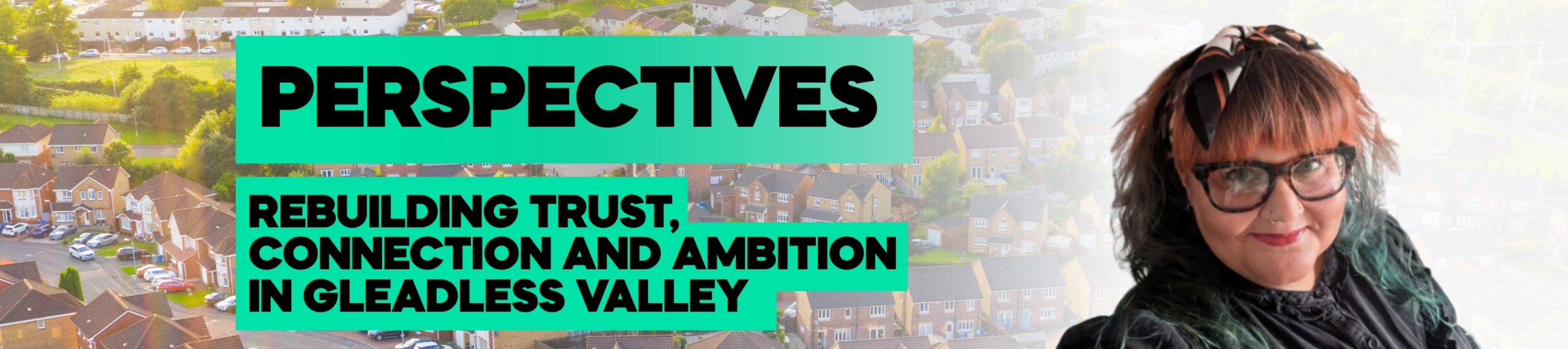
Lara Joyce, Secretary of the Gleadless Valley Tenants and Residents Association shares how a ‘Resident Power’ approach to the regeneration of Gleadless Valley has built trust and established an important community role in the future of the area.
I am Lara Joyce, Secretary of the Gleadless Valley Tenants and Residents Association. Gleadless Valley is a large estate in the South-West of Sheffield, sitting approximately 2.5 miles from the city centre with a population of around 21,000. It was originally developed in the 1950’s and 60’s. As Sheffield grew, the need for more housing led to the procurement of the steep hilled farms and woodland, that became a highly sought after estate. Upon completion, it drew people by the bus load from the continent, to admire the revolutionary approach to design and layout. More recently, however, if you were to look up this area on the internet, you would learn how it currently sits in the top 10% of most deprived areas in the country. The census data for employment, education and health levels do not make for positive reading. In contrast, however, when in S14, you are surrounded by ancient woodland, spectacular views and a community spirit that continues to thrive.
The housing stock is now of mixed ownership, with roughly 50% still owned by Sheffield City Council. The estate comprises flat roofed terraces descending the hillsides, and low-rise tower blocks bookending the Valley boundaries. Old three storey ‘mini’ tower blocks line one of the main roads through the area, truly showcasing the brutalist nature of the architecture here. There are rows of balconied maisonettes, three-tiered houses that sit in square blocks of four, and well sized double front doored terrace homes. These mix and match with the backdrop of stunning woodlands, that can be dated back to the 1400s, once coppiced to power Sheffield’s world-famous steel industry. Building on the terrain here was no mean feat, yet was achieved, and celebrated. A representation of ambition and determination to not let the hills become a barrier to possibility.
The concept of estate regeneration has hovered in the air here since 2017, with the publication of the ‘Masterplan’. This council document brought the promise of refurbishment, demolition and new homes. World events, a pandemic, Brexit, and war in Europe, gave way to soaring costs of materials and labour, thus heavily affecting the feasibility of this proposal.
2022 brought about a new approach, a refresh. One that took the original plan but asked for more. This time, taking a wider view of the regeneration of Gleadless Valley, assessing jobs, skills, transport, blue and green space, children and family services, local centres and housing. It strives to put the community at the heart, with Resident Power being a top priority and steering the decisions made. In December 2025, the ‘Vision for The Valley’ was approved by Sheffield City Council, and, as a community advocate, I was able to stand in front of those at the highest level of Council office and make a bid for the betterment of my local area.
The production of this vision has had learning curves steeper than the valley sides at times. The biggest challenges encountered have been around the issues of trust. The original masterplan offered so much to so many, building up expectations, yet totally failing to deliver. Living with uncertainty about the roof above your head is a pressure that few of us would thrive under.  Lack of progress was noted, questions doubled that didn’t have answers, and the pot of money that was proffered halved. Understandably, the community switched off. So, when the refresh began, work needed to be done to bring residents along on the journey for the second time. A chorus of ‘why?’, ‘when?’ and ‘what?’ still echoes around the valley as the council and community partners bang the drum for the vision. We believe that through making small but impactful changes, the community can see the commitment to the bigger picture.
Projects so far include the introduction of ‘Team Around the Place’ (TAP), a centralised, community-led approach to reporting and managing problems like fly tipping, anti-social behaviour, and street maintenance. With a dedicated Neighbourhood Manager and Place-Based Forum, TAP brings together local people, council staff, and partners to make the area cleaner, greener, and safer. This has streamlined the often-confusing world of council departments and contracted service providers which can be difficult to navigate. Also, a new ‘Pocket Park’ is being built. Designed to lift the mood for those on the often-monotonous school run. Offering a relaxed, informal play space in an area, whilst known for its outdoor space, that was lacking in structured play. These initial measures serve as a bridge between possibility and action. They are meaningful symbols of regeneration that tackle pressing community problems. They go a way towards repairing the trust that was broken.
 The Regeneration Team is staffed by dedicated council officers that want to make change happen too. They strive to resolve conflict and misinformation through meaningful connections, working hours beyond the standard 9-5, adapting to the local needs to interact directly with those who call the valley home. By having honest, transparent conversations, sharing realistic time scales and budgets, the levels of community understanding and resilience, rather than resistance, is growing.
In my experience, a holistic approach to regeneration is vital. One which puts residents central, provides safe and affordable housing, addresses the barriers the area faces to work and education, and weaves trust through it all, even when the truth isn’t pretty, will have the best chance of success.
From many viewpoints in the valley, you can see the Peak District, iconic sports grounds and two well-respected universities. Those varied landmarks should be seen by the residents and know that whether they’re academic, practical or sporty, there is something out there for them beyond the boundary of S14. My belief is that your postal code does not determine your worth, value, or capabilities. However, when it feels as though where you call home isn’t worth investing in, people can lose their feeling of connection and their sense of value in ‘place’, subsequently disengaging completely. Through meaningful regeneration, residents in areas in Gleadless Valley can look across the city and see a real, achievable future before them, a future that with investment in their roots, can give them hope to grow.
The perspectives collection showcases a range of opinions about regeneration. The views expressed in the articles are the author’s and do not necessarily reflect the position of the NHC or the Renew inquiry.