
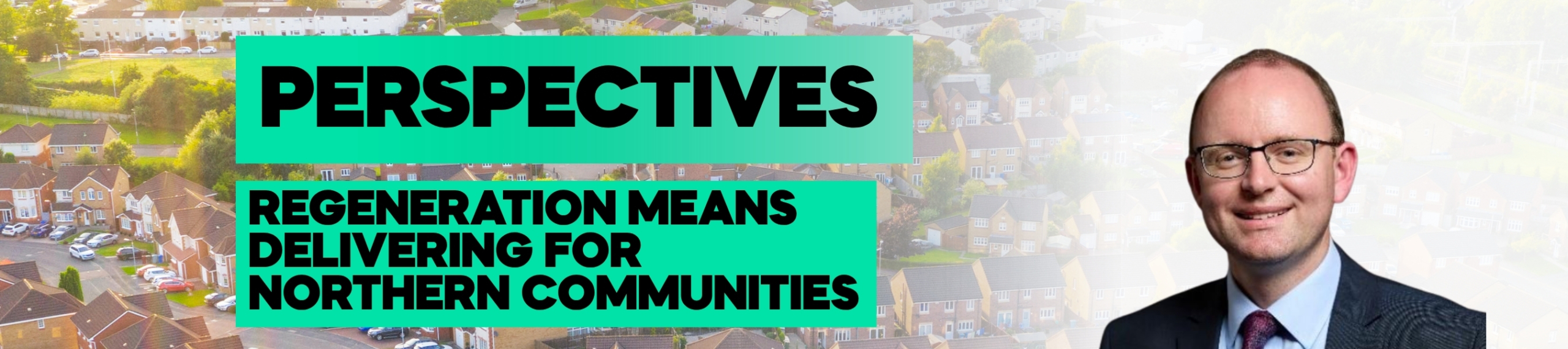
Andrew Cooper is MP for Mid Cheshire, Chair of the Renew Westminster Group and member of the Housing, Communities and Local Government Select Committee. He sets out how housing-led regeneration gives Government the opportunity to connect national objectives – growth, opportunity, and fairness – with the everyday places where people live their lives. Renew embodies the collaborative, evidence-driven approach needed to make the most of current opportunities to make a difference.
Poor housing touches every part of a person’s life, and the consequences can be profound. Families crammed into overcrowded homes, and the strain this places on children’s ability to learn and thrive. People living with damp and mould, and the damage this does to their physical and mental health. Households in draughty, poorly insulated properties struggling to heat their homes and keep up with rising energy bills.
Housing is a policy area where getting it right can truly transform lives, not only by ensuring people have a safe and secure place to live, but by improving educational outcomes, strengthening health, and helping families make ends meet. That is why this agenda matters so deeply; because a good, safe, affordable home is the foundation on which a good life is built.
The Government understands this and its transformational investment in social and affordable housing marks a pivotal moment in national policy. It does more than allocate funding; it signals a shift in purpose. After years of fragmented initiatives, we are beginning to see the emergence of a more ambitious, more place sensitive approach to tackling the housing crisis. It is an approach that recognises the diverse realities of our towns, cities, and rural communities, and the different tools required to support them.
Crucially, the Government has acknowledged that delivering on both housing and regeneration is central to its future mission. Tackling housing poverty, expanding the supply of social and affordable homes, and revitalising neighbourhoods are not marginal addons, they are fundamental to economic growth, social stability, and national renewal. The Pride in Place programme, with its focus on reviving high streets and improving public spaces, underlines this commitment, linking physical transformation with wider social outcomes across education, health, and community safety.
What makes this moment especially significant is that ambition is now backed by serious investment. The Affordable Homes Programme, the introduction of new low interest loans for social housing providers, and the launch of a decade long Plan for Neighbourhoods show a willingness to think long-term. Many of the communities that stand to benefit from this investment are in the North. For them, these announcements are not abstract policy concepts, they represent the building blocks of a better future.
At the same time, important changes to the Treasury’s Green Book have altered how public funds are assessed and allocated. By placing greater weight on social value, wellbeing, and local need, the system now opens the door to investment in places that have too often been overlooked. For those working at the intersection of housing and regeneration, this shift is more than a technical reform. It creates a policy environment where long-term, community-led renewal is more achievable, more defensible, and more likely to be sustained.
 Regeneration is not simply about bricks and mortar. It is about restoring pride, creating opportunity, and building resilience. Ultimately, it is about ensuring that people not only have a decent home, but a meaningful stake in the place they live. That is why housing-led regeneration must be central to the national housing agenda. New homes are essential, but they are not enough. We must also invest in the homes that already shape people’s everyday lives and the neighbourhoods that define their sense of belonging. Regeneration cannot be treated as an optional extra. It is a core component of building a fairer, greener, more prosperous North.
The Renew inquiry is a key component of this. By bringing together housing providers, local leaders, developers, policymakers, and regeneration specialists, a clear message has emerged from this engagement; collaboration is the key foundation for success. If we want to deliver regeneration that lasts, we need to work across boundaries, share knowledge openly, and build partnerships rooted in trust and shared ambition.
This is precisely why the Renew inquiry is so important. It embodies the collaborative, evidence-driven approach that this moment demands. The inquiry will help shape a deeper understanding of how regeneration can drive growth, reduce inequality, and strengthen the social fabric of Northern communities.
Housing-led regeneration is uniquely positioned to act as a bridge between policy areas and to help articulate a coherent national narrative. It demonstrates, in a tangible way, what investment in neighbourhoods looks like in practice. From the home to the high street, regeneration joins up the physical and social aspects of placemaking. It helps counter feelings of mistrust and division by showing that change is being delivered with communities, not imposed upon them. In this way, it provides a powerful exemplar of the Government’s ambition: visible, local, and rooted in everyday life.
But to deliver on this promise, the work cannot be left to central government alone. Everyone must be involved. Local authorities, housing associations, developers, investors, community organisations, and residents all have a role to play. We must create the conditions where collaboration is the norm, where barriers are reduced, and where every partner is empowered to contribute. The most successful regeneration is grounded in local insight. It listens to communities, respects their knowledge, and builds solutions that reflect their aspirations.
 Parliament also has a crucial role. The Renew inquiry offers MPs a direct line to the people and organisations shaping regeneration on the ground. By visiting projects, hearing from residents, and staying close to the evidence, parliamentarians can ensure policy reflects lived experience rather than abstract models.
As we look ahead, the message is clear: this is a moment we cannot afford to waste. The frameworks are improving. The investment is growing. The partnerships are emerging. What we need now is the resolve to turn ambition into action.
Housing-led regeneration gives us a way to do just that. It provides a practical route to deliver better homes, stronger neighbourhoods, and more confident communities. It allows us to connect national objectives – growth, opportunity, and fairness – with the everyday places where people live their lives.
If we seize this moment, we can deliver something truly transformative. Not piecemeal change, but lasting renewal. Not short-term fixes, but long-term investment in the future of the North. The tools are now on the table. It is up to all of us, government, local leaders, the housing sector, and communities themselves, to use them well.
The perspectives collection showcases a range of opinions about regeneration. The views expressed in the articles are the author’s and do not necessarily reflect the position of the NHC or the Renew inquiry.